On this page
WHAT IT TRAINS
The muscles that pull.
Your back muscles pull the bar in. Your shoulders and arms work in the pull too. Through all of it, your back stays flat. [1] [2]
BEFORE THE REP
Setup.
HOW TO DO A REP
How to do a rep.
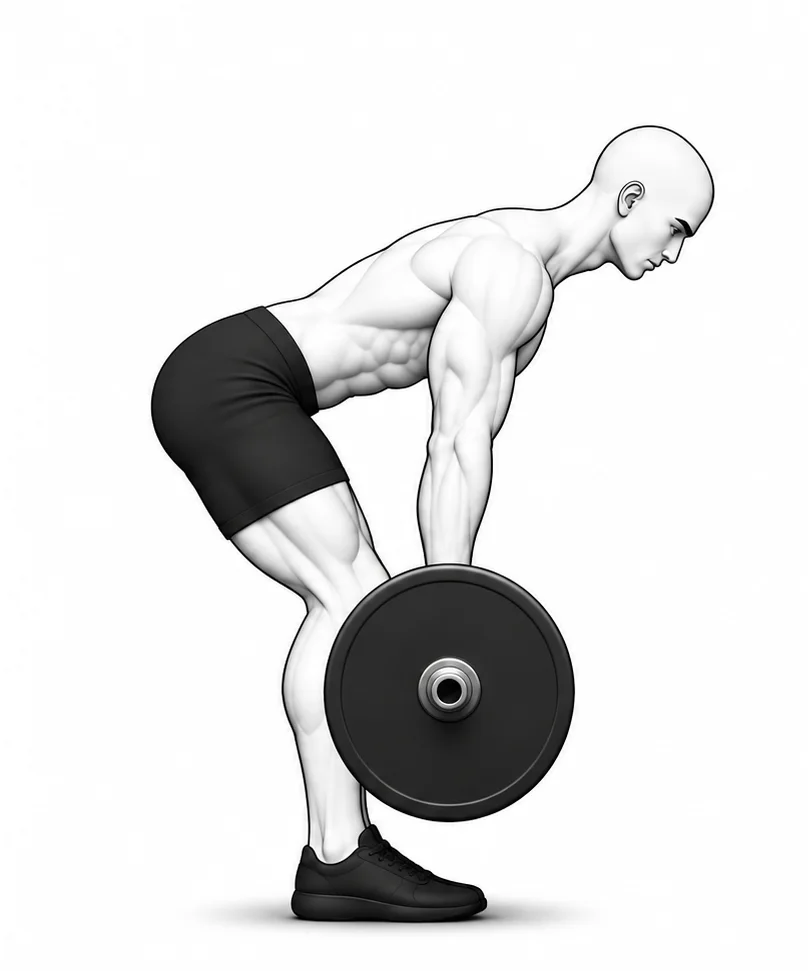
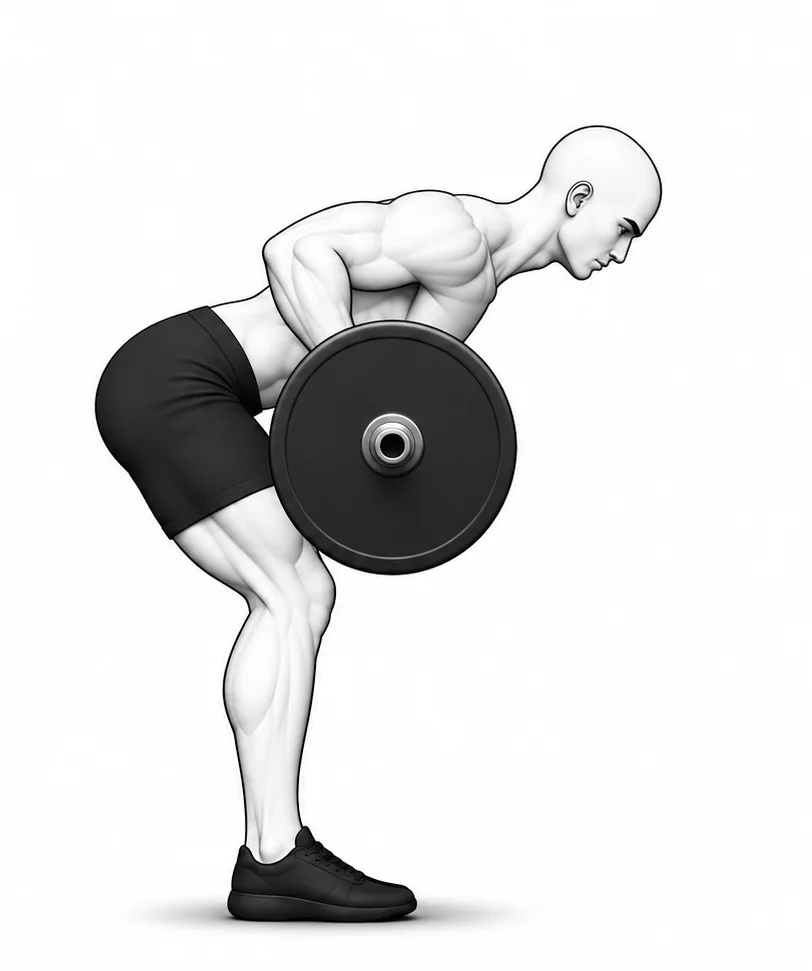
Pull toward your belly button.
Bring the bar in toward your belly button. Guides differ on the exact finish: some stop at your belly button, others pull as high as the bottom of your breastbone. [1] [2]
Keep your back flat.
Use your full range.
Start each pull from fully straight arms and bring the bar all the way in. [1] [2]
Lower to straight arms.
Lower the bar back down until your arms are straight again. [1] [2]
WHAT TO WATCH FOR
Common mistakes.
SAFETY
Safety.
- Keep your back flat on every rep. [1] [2]
- Check with a doctor or physical therapist first if you have an injury, pain or a medical condition, or are pregnant.
- Stop the set if you feel sharp pain, joint pain, dizziness or chest pain. Muscle burn and effort are normal; pain is not.
- This page is general information about exercise technique. It isn't medical advice and doesn't replace advice from a professional who knows your health. See our Terms of Service.
SIMILAR EXERCISES
Similar exercises.
Lifts in the Liftometry catalogue that share the barbell row’s main muscle group (back) and movement pattern (row), in alphabetical order.
HOW LIFTOMETRY TRACKS IT
How Liftometry tracks your barbell row.
- Set methods
- Liftometry scores straight sets, drop sets and myo-reps each against their own history.
- Beating last time
- At the same weight, more reps count as a beat. At different loads, Liftometry compares estimated 1RM or says the sets aren’t directly comparable.
- Estimated 1RM
- In Liftometry, more reps at a lighter weight can raise your estimated 1RM without counting as a beat or a PR.
- PRs
- For straight sets, a PR needs a heavier weight than your best, or more reps than the same set last time at the same or a heavier weight.
YOUR PROGRAM. MEASURED PROPERLY.
Log it in Liftometry.
First workout: no account and no payment.
Log it in Liftometry.

EVIDENCE & LIMITS
Sources you can inspect.
- Bent-over Row (ACE Exercise Library)
Technique reference · American Council on Exercise. Barbell bent-over row: grip, hip hinge with a straight back and slight knee bend, arms straight at the bottom, pull toward the belly button; lists arms, back and shoulders as target body parts. Does not rank muscles or name individual ones. Checked 21 November 2026.
- Correcting the Bent-Over Row
Technique reference · National Council on Strength & Fitness. Continuing-education article on the barbell bent-over row: flat back, pronated grip, pull landing between the belly button and the xiphoid process, common errors. Names no muscles for this lift other than back, biceps, middle trapezius and trunk stabilizers. Checked 21 November 2026.
Published by Liftometry. Each technique or safety statement on this page is supported by at least two independent published sources listed here; where sources differ, the page says so. Research findings are shown with their limits. Listing a source does not mean it endorses this page. Last updated 21 November 2026.