Myo-reps
Myo-reps are an activation set taken close to failure, followed by short mini-sets of a few repetitions with only a few breaths of rest between them, all with the same weight [1]. Borge Fagerli developed the method in 2006 [1]. A recent study found myo-reps built similar muscle and strength to straight sets in less time [2].
What is a myo-rep?
A myo-rep set has two parts. First comes an activation set: a weight you can lift for about 9–20 repetitions, taken to failure or one or two repetitions short of it, judged by when the repetitions slow down. Then come mini-sets: a few repetitions at a time with the same weight, separated by very short rests [1].
Fagerli describes the rest as about five deep breaths, roughly 10 seconds, and no more than 30 seconds. Mini-sets are a few repetitions, sized to the activation set: in his schemes, 3 after an activation set of 9–12, 4 after 12–15 and 5 after 15–20 [1]. You keep going until you can't complete the mini-set you planned.
How to do myo-reps
- Pick a weight you can lift for about 9–20 repetitions. Fagerli doesn't use loads heavier than about a 5-repetition maximum for this method [1].
- Do the activation set to failure or one or two repetitions short, when the repetitions noticeably slow [1].
- Rest about five deep breaths, roughly 10 seconds, and never more than 30 [1].
- Do a mini-set of a few repetitions with the same weight: in Fagerli's schemes, 3 to 5 depending on the activation set [1].
- Repeat the rest and the mini-set until you can't complete the mini-set's target. That is where the block ends [1].
Example: a myo-rep set
EXAMPLE (SAMPLE NUMBERS)
- Leg Extension, 110 lb.
- Activation set: 15 repetitions, stopping one short of failure.
- About 5 breaths, then a mini-set of 5.
- About 5 breaths, then 5.
- About 5 breaths, then 4: the target of 5 was missed, so the block ends.
Block total: 15 + 5 + 5 + 4 = 29 repetitions with one weight.
Fagerli's own example is 200 lb for 10, then mini-sets of 3, 3, 3, 3 and 2: about 25 repetitions in two minutes, against about six minutes for three sets of 10 [1].
Which exercises suit myo-reps?
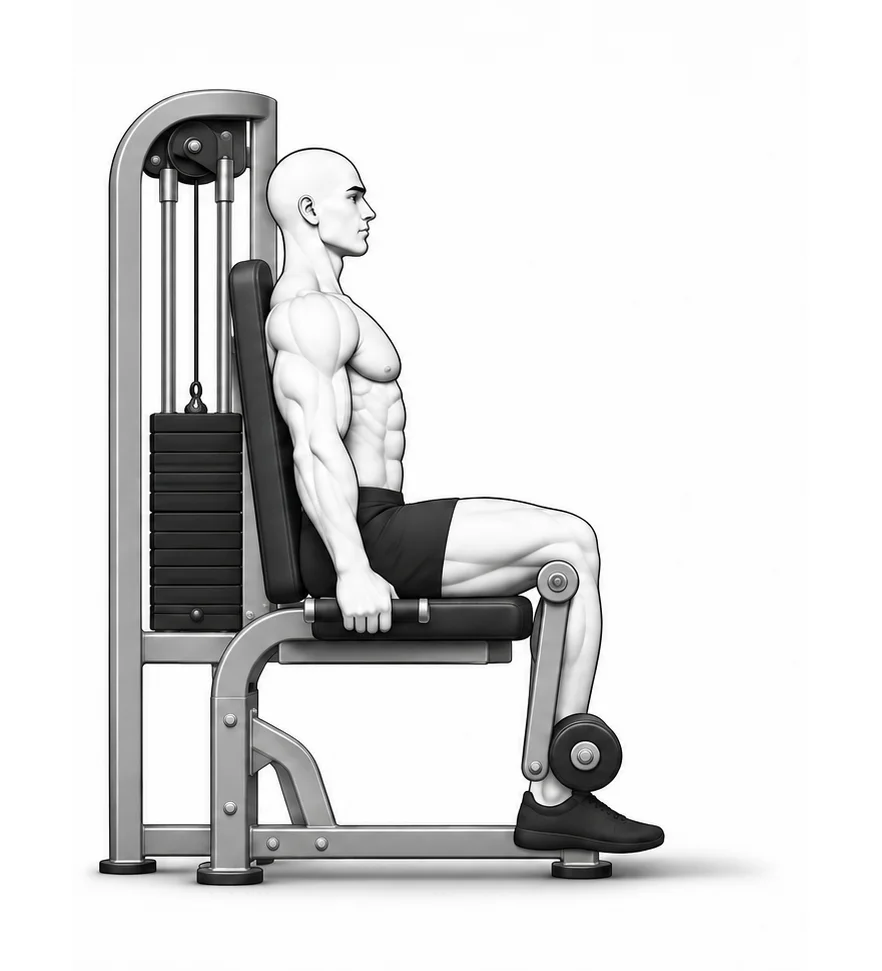
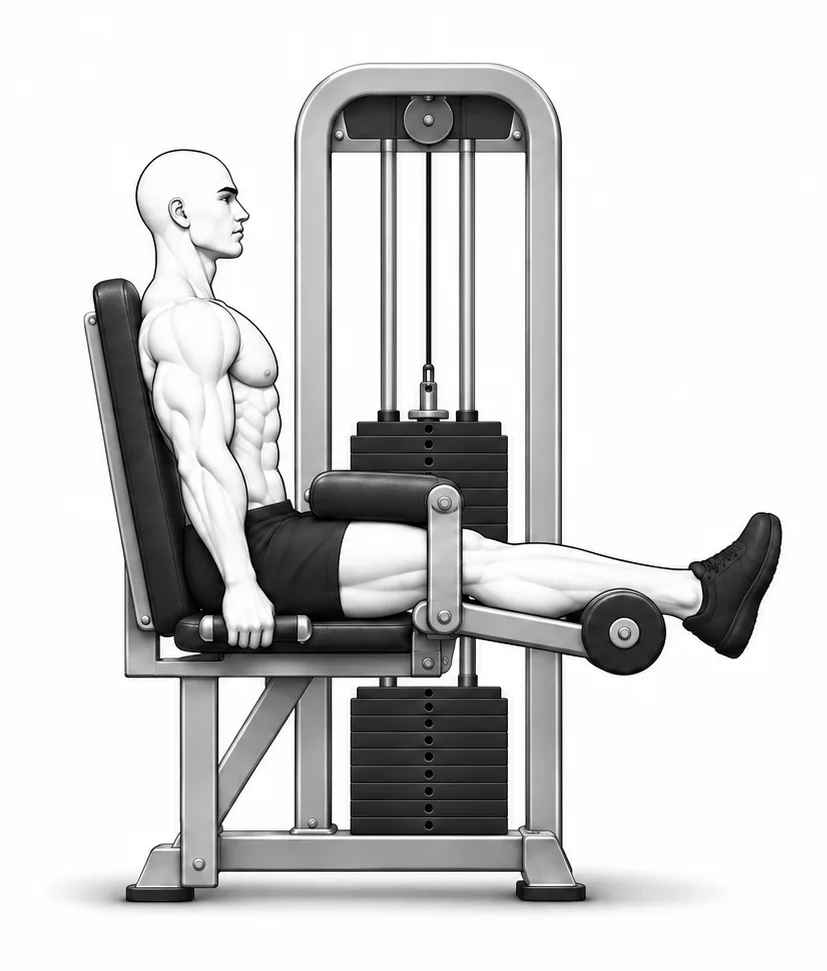
Exercises where you can stop and start within a few seconds, with a weight you can lift 9–20 times: machines, cables and single-joint exercises such as leg extensions, leg curls, lateral raises, curls and pushdowns.
Fagerli doesn't use myo-reps for dumbbell presses, and advises care with squats, deadlifts and bent-over rows, where lower-back fatigue builds up across the mini-sets [1].
Common myo-rep mistakes
Resting too long. The rests are meant to be about 10 seconds, up to 30 at most [1]. A full rest turns the mini-sets into ordinary sets.
Stopping the activation set too early. It is meant to go to failure or one or two repetitions short [1].
Going too heavy. The method is built around 9–20 repetitions on the activation set, not heavy low-repetition loads [1].
Ignoring the stopping rule. The block ends when you can't complete the planned mini-set [1], not after a fixed number of mini-sets.
How myo-reps compare
Myo-reps vs rest-pause #
Myo-reps are a kind of rest-pause [1]. Both use short rests to add repetitions with the same weight. Myo-reps use a lighter, higher-repetition activation set (about 9–20) and stop when a planned mini-set can't be completed [1]. A well-known rest-pause study started heavier, at 80% of a one-repetition maximum [5].
Myo-reps vs straight sets #
Straight sets rest a minute or more between sets. Myo-reps compress similar work into one block. In an 8-week study in trained men, myo-reps and straight sets gave similar muscle and strength gains, and the myo-rep sessions were shorter [2].
What the research tested
One session, timed (Bradshaw et al., 2026) #
Nine trained men did the bench press both ways. The myo-rep session was significantly shorter, while muscle activity and bar speed did not differ [2].
Eight weeks of chest training (Bradshaw et al., 2026) #
Twenty-two trained men trained the flat bench, incline bench and cable fly twice a week for 8 weeks, with myo-reps or straight sets. Muscle size and strength rose in both groups with no difference between them, and the myo-rep group lifted about 30% less total volume [2].
Rest-pause over 6 weeks (Prestes et al., 2019) #
Eighteen trained people did rest-pause training or traditional training (3 sets of 6 at 80% of a one-repetition maximum, 2-minute rests) for 6 weeks. Maximal strength rose similarly; thigh muscle thickness rose 11% against 1%, and leg-press endurance 27% against 8% [3].
Do myo-reps work?
The first trial of myo-reps found they matched straight sets in less time. In 22 trained men over 8 weeks of chest training, both groups gained muscle and strength, with no difference between them, and the myo-rep group lifted about 30% less total volume [2]. In the same paper's short test, a myo-rep session took significantly less time than straight sets [2].
Research on the wider rest-pause family points the same way: rest-pause training produced similar or better results than traditional sets in trained lifters [3][4].
The evidence is still thin. There is one dedicated myo-rep trial so far, in trained men and for chest exercises only [2], so results for other groups and exercises aren't yet tested.
How Liftometry records myo-reps
See how Liftometry records myo-reps #
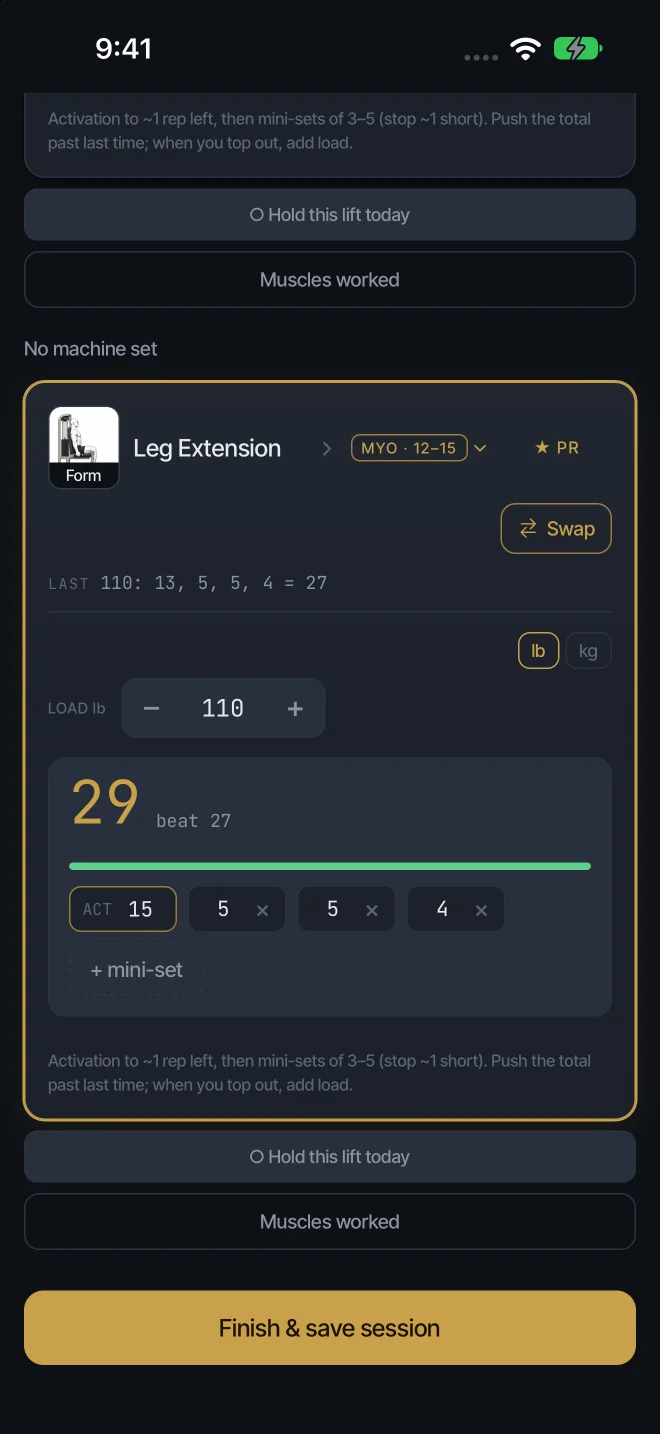
Choose Myo from the method badge on the lift's card. Enter the weight, the activation reps in ACT, and add each mini-set with + mini-set. Liftometry does not run a rest timer between mini-sets, on the phone or the Watch; you take the short rests yourself.
How Liftometry scores it #
Myo-reps are scored on reps: the total across the block, activation and mini-sets together. A block is a PR when its total beats your best block at the same or a heavier load. Your first myo block sets the record; it is not a PR.
In the weekly volume by muscle on the Progress tab, a myo block counts the activation set plus each mini-set as hard sets.
On Apple Watch #
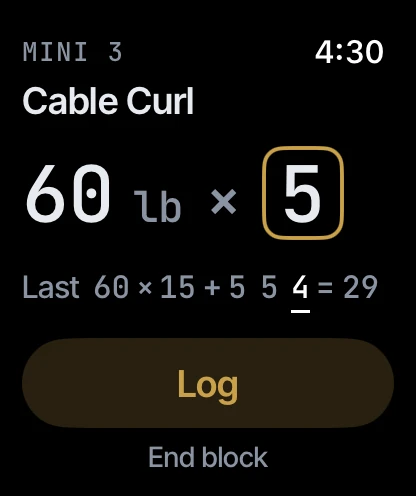
On the Watch, log the activation set, then each mini-set, and tap End block when you are done.
Questions people ask
What is a myo rep? #
An activation set close to failure, followed by short mini-sets of a few repetitions with about 10 seconds of rest, all with the same weight [1].
Do myo-reps actually work? #
In the first trial, 8 weeks of myo-reps gave trained men similar muscle and strength gains to straight sets, in shorter sessions [2]. It is one study, so the evidence is still limited.
Can you give me an example of a myo rep? #
Leg extension at 110 lb: 15 repetitions, about five breaths, then 5, 5 and 4, for 29 in all. Fagerli's own example is 200 lb for 10, then 3, 3, 3, 3 and 2 [1].
What's the difference between myo-reps and rest-pause? #
Myo-reps are a form of rest-pause with a higher-repetition activation set and a stopping rule [1]. See rest-pause sets.
More set method guides
Next guide: Rest-pause sets. Also: Supersets, Drop sets, or all set method guides.
Lifts it suits
Sources
- 1Fagerli B. Myo-reps in English. borgefagerli.com, 1 May 2012 (archived copy; first published on mountaindogdiet.com). web.archive.org/web/20130226050938/http://borgefagerli.com:80/myo-reps-in-english
- 2Bradshaw JT, Sanzo K, Barakat C, et al. Similar strength and hypertrophic adaptations in less time? Myo-reps vs. traditional straight-sets in resistance-trained men. J Strength Cond Res. 2026;40(6):638–49. pubmed.ncbi.nlm.nih.gov/42112925
- 3Prestes J, Tibana RA, de Araujo Sousa E, et al. Strength and muscular adaptations after 6 weeks of rest-pause vs. traditional multiple-sets resistance training in trained subjects. J Strength Cond Res. 2019;33 Suppl 1:S113–21. pubmed.ncbi.nlm.nih.gov/28617715
- 4Enes A, Alves RC, Schoenfeld BJ, et al. Rest-pause and drop-set training elicit similar strength and hypertrophy adaptations compared with traditional sets in resistance-trained males. Appl Physiol Nutr Metab. 2021;46(11):1417–24. pubmed.ncbi.nlm.nih.gov/34260860
- 5Marshall PW, Robbins DA, Wrightson AW, Siegler JC. Acute neuromuscular and fatigue responses to the rest-pause method. J Sci Med Sport. 2012;15(2):153–8. pubmed.ncbi.nlm.nih.gov/21940213